Guide
Teachers, Mentors and the student agree the goals, the priorities, the standard to aim for and what comes next.
Teaching and learning
We plan a child’s education around how that child develops, and a live lesson is one piece of it. The school sets the framework and the standards. Your child owns the learning from the start, and this page shows how the rest fits round them.
Students help shape their learning at every one of these steps. What grows over the years is how well they decide for themselves.
Teachers, Mentors and the student agree the goals, the priorities, the standard to aim for and what comes next.
The student works with new knowledge in more than one way: a live session, a recording, reading, a guided activity, their own investigation.
Students use what they’re learning. They solve, write, explain and apply it until they can do it.
With learning and practice come skills, habits, judgment and the persistence to keep going.
Students direct more of their own learning: they organise their work, judge their progress, ask for support and decide what should happen next.
Seven things have to be right for learning to be rigorous. Each is below, with what it means for your child.
Rigorous
Your child follows a recognised curriculum, with a clear standard for every stage and a clear way on to the next.
Rigorous
Teachers plan the order of learning, so your child meets each idea, question and piece of practice at the right stage.
Rigorous
In a lesson your child is working: reading, solving, writing, discussing, investigating.
Rigorous
Assessment shows us what your child has understood, what isn’t secure yet and what should happen next.
Rigorous
Feedback shows your child what good work looks like, where theirs falls short and how to improve it.
Rigorous
Students put what they know to use in problems, projects, research and real situations.
Rigorous
Students take part in decisions from the start, and manage more of their own learning as they show they can.
It means taking knowledge seriously: the standard, the practice, the evidence and what a student can do with it.
A live lesson matters, and it’s one of eleven things we plan around your child.
What each part does
The school decides what should be learned, why it matters, in what order, and what good work looks like.
In a live session a teacher explains, questions, models and challenges, and students answer in real time.
Students work through materials and tasks that have a clear purpose, making choices and managing their work as they go.
We use what we know about your child, their starting point, progress, strengths, interests and goals, to shape guidance and next steps.
Students use what they know again and again, until understanding becomes something they can do.
Assessment gives us evidence. Feedback helps your child read that evidence and improve.
Every IWS student receives mentoring that fits their learning model. A Mentor connects a student’s progress, habits, motivation, organisation and next steps.
Students learn to read their own learning: what’s working, what isn’t, and what to do next.
Children learn better when they belong to a community that knows, respects and supports them.
Students work with others: they contribute, disagree well and learn together.
Students take what they learn further through leadership, service, competitions, research, creative work, public speaking and projects.
A week mixes live teaching, recordings and independent study.
Timetabled lessons, taught in real time by qualified teachers, with classmates in the room.
Recordings sit alongside the live lessons, so a student can go back over what was taught and revise calmly.
Work students do on their own, to a plan. It builds confidence and self-discipline.
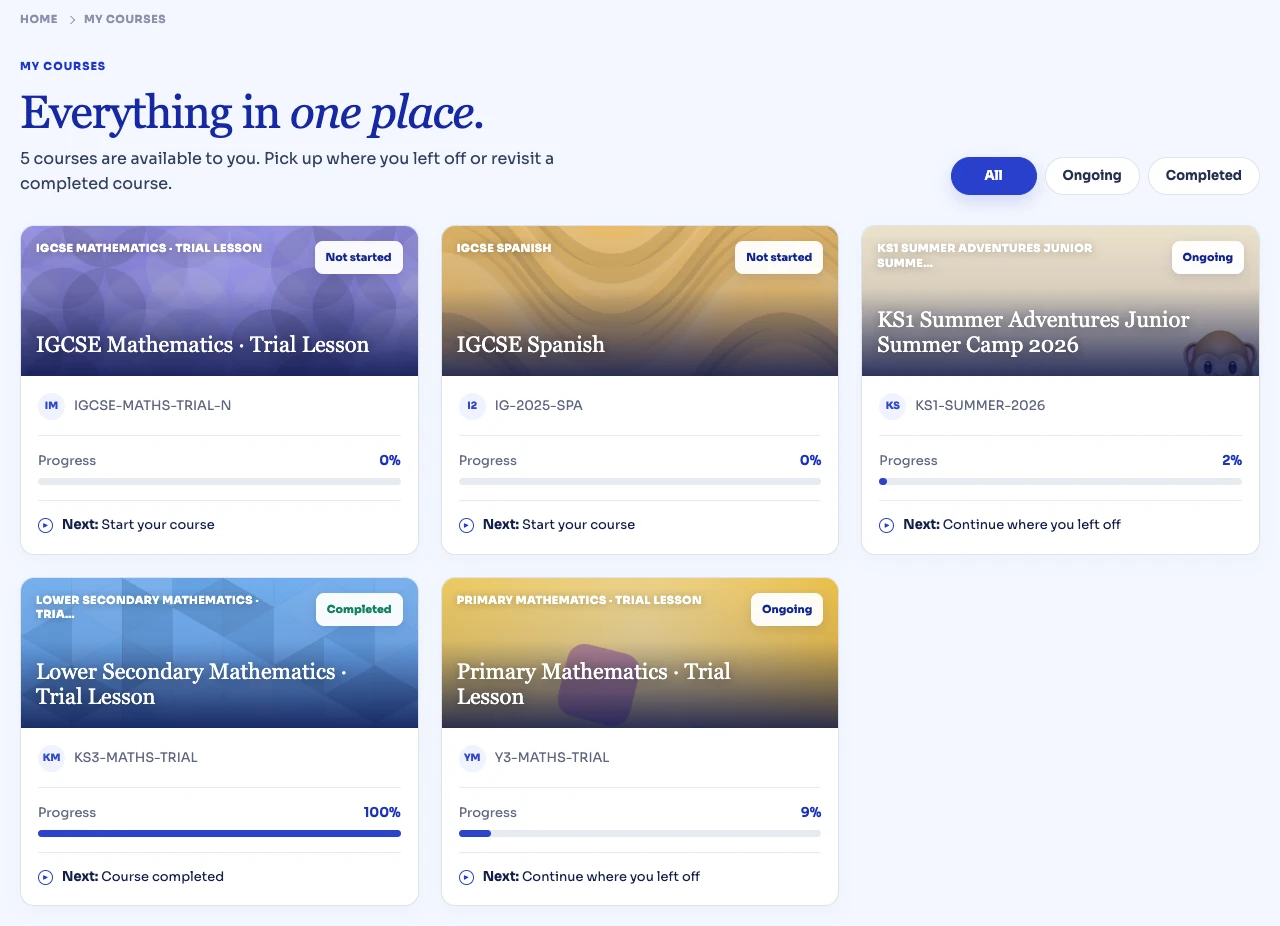
Everything your child needs is in one online classroom: their lessons, their materials and their progress.
Your child has a job in their own learning. So do their teachers, their Mentor and the school.
Agency and direction
The student is the captain of the learning.
From the beginning, students are involved in
We give students a real say early, and help them build the judgment to use it well.
Academic direction and challenge
Teachers bring the subject: what to learn and in what order, clear standards, explanation, questions and challenge. They spot what a student has misunderstood, assess the work and give feedback, so that students understand, think well and move on.
Continuity and whole-student guidance
A Mentor keeps the wider view of each student: their goals, progress and habits, what’s getting in the way and what should happen next.
Every IWS student receives mentoring that fits their learning model.
Mentoring at IWSCoherence
The school makes sure curriculum, teaching, materials, assessment and mentoring all work round the same child, so everything a family gets from us fits together.
The table sets IWS beside two models you may already know.
| Dimension | Conventional school model | Typical content-led online model | IWS |
|---|---|---|---|
| Centre of the experience | Timetable, classroom and teacher delivery | Content access and flexibility | Learner development |
| Main unit of learning | Lesson | Course or recording | Integrated learning experience |
| Student position | Primarily follows the established programme | Often manages study largely alone | Owns the learning and participates in decisions from the beginning |
| Adult contribution | Teaching, supervision and assessment | Content delivery and occasional support | Academic direction, challenge, feedback, mentoring and removal of learning bottlenecks |
| Self-directed learning | Often secondary to classroom instruction | Often assumed | Deliberately developed through guidance and practice |
| Personalisation | Often limited by whole-class structures | Often based on pace or access | Informed by evidence about the individual learner |
| Mentoring | May sit within pastoral or advisory structures | Often limited or optional | Part of every IWS learning model |
| Additional academic support | Usually shaped by timetable, staffing or separate support structures | Often limited to scheduled support or paid-for extra help | Within Academy, extra academic support with no fixed limit when a student falls behind agreed academic goals |
| Personal development | Commonly expressed through pastoral care, wellbeing or extracurricular provision | Often outside the core offer | A structured core offering within Academy through the Well-Rounded Programme |
| End goal | Academic progression and qualification | Completion and flexibility | Academic achievement plus human capability, autonomy, authority and responsibility |
We set goals with each student: ambitious ones that they can reach. Every child can achieve, and when one needs more academic support the school stays accountable for it.
When an Academy student falls behind an agreed academic goal, we take responsibility for getting them back on track. They get extra academic support, with no fixed limit, until the difficulty behind it is dealt with and they can move forward again.
Compare the three learning modelsBook a Consultation and we’ll walk you through a typical day of learning at IWS. You can try a 30-minute lesson with a qualified teacher, and take a look inside the learning platform, at no charge.